
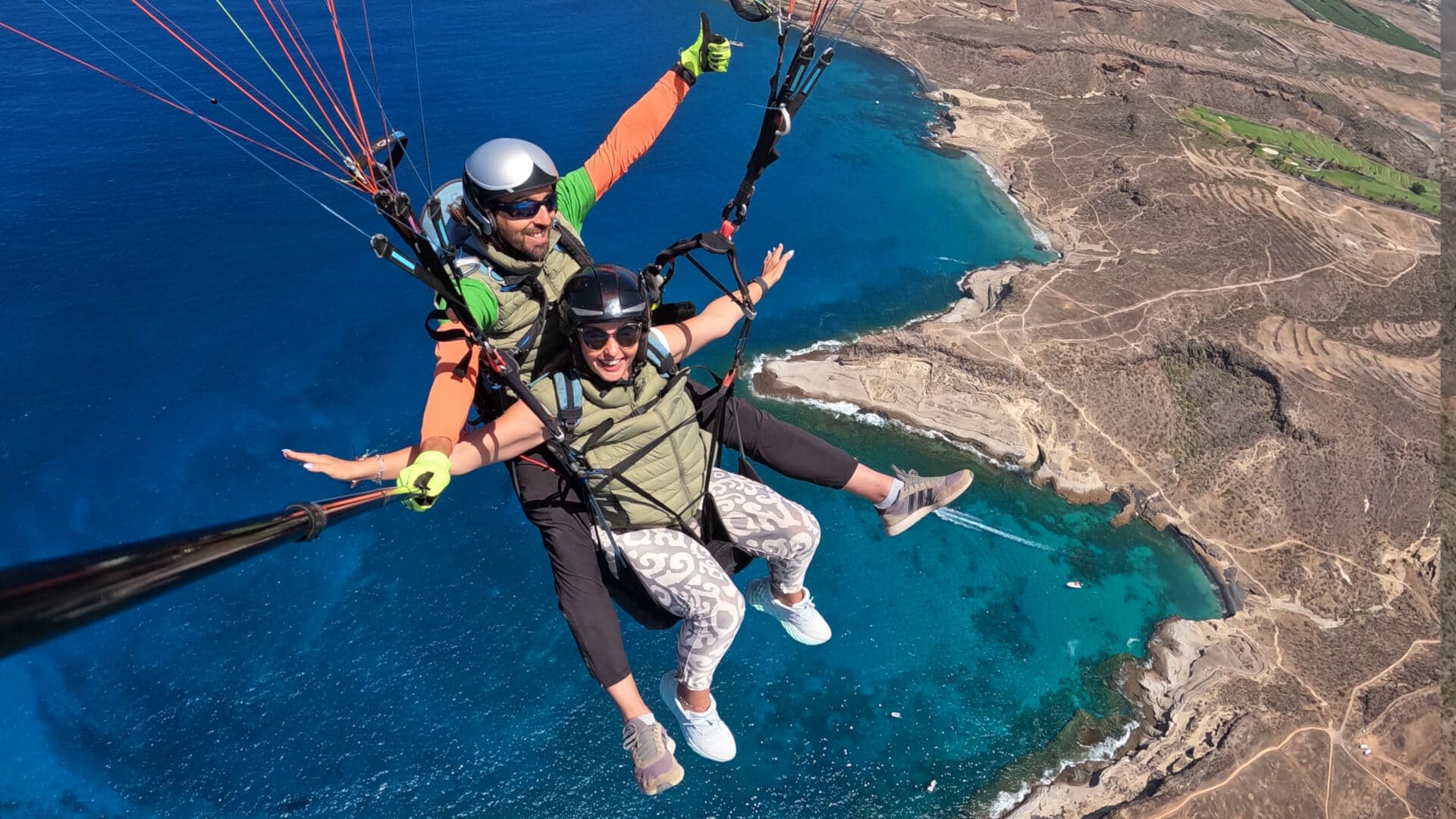
If you have never been paragliding, everything about it sounds impossible. Running off a mountain. Hanging from a piece of fabric. Landing on a beach. It is normal to be nervous. What follows is exactly what happens, in order, from the moment we pick you up to the moment you are back at your hotel, so nothing is a surprise.
What to wear
Closed shoes. Trainers are perfect; running shoes, hiking shoes, anything closed is fine. No flip-flops, no sandals. You will take a few brisk steps at takeoff, and you want your feet firmly attached to you.
Comfortable clothes you can move in. Leggings, jeans, trousers are all fine. Skirts and dresses technically work but most people prefer trousers for the sit-down landing option.
Sunglasses are a good idea. Prescription glasses are fine under the helmet, they stay put. A light jacket even if the beach is thirty degrees; at altitude the air is 10 to 15 degrees cooler and moving through it adds wind chill.
Everything else we provide: helmet, harness, and the glider itself. You do not need to bring anything other than yourself, some ID for the booking, and the clothes you are wearing.
The drive up
We pick you up from your hotel, or from a meeting point in Costa Adeje if you are staying further out. The drive is about thirty minutes up winding mountain roads.
Your pilot uses the drive to brief you. Three things get explained: what to do on takeoff, what to do in the air, and what to do on landing. All three are simple. None of them involve you doing anything complicated. If you remember "run forward", "sit back", and "lift your legs", you have it.
Takeoff: the part everyone worries about
Here is the truth about takeoff. You do not jump. You do not leap. You take a few brisk steps, and within those steps the ground stops being under your feet. It is gradual, not sudden.
Your pilot is clipped to the same glider, immediately behind you, controlling everything. The wing inflates over your head, you walk briskly forward into the breeze, and a few steps later you are flying. A surprisingly common reaction from first-timers at this moment is laughter. Not screaming, not fear, laughter. Because it is so much calmer than anyone expects.
If the wind is not right for takeoff at the exact moment, your pilot will stop and wait. Nobody pushes ahead on a takeoff that does not feel right. You fly when the air is ready.
What it actually feels like in the air
Nothing like a rollercoaster. Nothing like a bungee jump. Those are engineered shocks; paragliding is the opposite.
The closest honest comparison is floating in warm water, the pool is just several hundred metres deep, and the view is the entire south coast of Tenerife instead of pool tiles. You sit, not hang; the harness is a seat with leg supports and a back. You can talk to your pilot at normal volume because there is no engine. You can point at things. You can ask to take photos, and if your pilot says yes you can do it.
On a calmer flight you feel the gentle rise and fall of the air, like a boat on a very slow swell. On a thermal flight there is more texture but nothing that hurts, think of it as the air having grain, not bumps.
Landing: easier than you think
As you approach the landing beach, your pilot will ask you to lift your legs straight out in front of you. That is it. The pilot does the rest, lines up into the sea breeze, flares the wing to slow it, and you touch down either standing on your feet or, if the timing has you slightly higher than expected, with a gentle sit-down onto sand.
Playa de Enramada is wide, flat, and designed for this. You stand up, your pilot unclips you, and someone will take your photo if you want one, the standard "just landed, grinning" shot that every first-timer gets.
The fear question
"But I am afraid of heights." This is the most common thing passengers tell us before takeoff. The interesting thing is that paragliding is genuinely different from a balcony or a cliff edge. A balcony has an edge and something to fall from. Paragliding has neither.
You are sitting in a harness, suspended under a wing that wants to fly. There is no edge; there is nothing to fall off of; there is nothing for the fear-of-heights reflex to grip onto. Most passengers who are nervous before takeoff are smiling within thirty seconds of the launch.
If you are specifically anxious, our Calm & Smooth flight is designed for exactly this, a gentler site, gentler air, a calmer pilot pace. Tell us in the booking notes and we will make sure the flight matches what you need.
And then you are back
We drive you back to your hotel. The whole experience takes between ninety minutes and two hours door-to-door, depending on your pickup location. The flight itself is fifteen to twenty minutes for a standard tandem, but it will be the fifteen to twenty minutes that the rest of the day gets judged against.
Every passenger we have ever flown was a first-timer once. Nobody regrets the landing.
Next step
More than ten thousand flights over 15+ years. Your first one will not be the last memory you talk about from Tenerife.