Tenerife has dozens of tandem paragliding operators. Most fly the same two takeoff sites, use broadly similar equipment, and sit in a comparable price range. From a Google search result, the difference between them is invisible. This guide is how you actually tell them apart.
Certification matters, ask specifically
Every legitimate operator in Spain is licensed under AESA, the national civil aviation authority. That is the floor, not the ceiling. The useful question is what certification each individual pilot holds, and how recently it was renewed.
The standard in Europe is SafePro, a multi-level pilot progression originally developed in Scandinavia and adopted across the continent. SafePro Tandem is the specific rating that lets someone fly a paying passenger. It is renewed yearly, not once in a career, and the renewal includes a practical check ride.
Red flag: an operator who advertises that their pilots are "certified" without naming the system. Every serious pilot knows the name of their own credential. A vague answer usually means the certification is either old, regional, or both.
Our pilots hold SafePro Tandem, renewed annually. Ask any operator the same question. You will learn quickly which ones answer in detail and which ones change the subject.
Weight limits tell you about the equipment
Most tandem operators publish a passenger weight limit somewhere between 90 and 110 kilograms. Those numbers are not about discrimination or aesthetics. They are a direct function of the glider's certified load range and the condition of the equipment under it.
A newer, higher-rated tandem glider carries more weight safely. An older wing whose load certification is near the bottom of its original range cannot. When an operator sets a limit at 90 or 95 kilograms, that is often telling you something about the rotation of their fleet.
Our limit is 110 kilograms. We fly Ozone, Gin, Advance, and Woodyvalley wings, the full fleet renewed annually, not at end of service life. The higher limit is a consequence of the equipment, not a marketing choice.
Do you fly, or do you ride?
Most tandem flights follow the same script. Your pilot straps you in, runs with you off the takeoff, flies for fifteen to twenty minutes, and lands. You sit, you look around, you take photos. It is genuinely beautiful, and for many passengers that is enough.
But if you are the kind of person who reads the manual before assembling the bookshelf, if what you want is to understand what paragliding actually is, not just see it from the seat, ask whether the operator runs a flight where you learn.
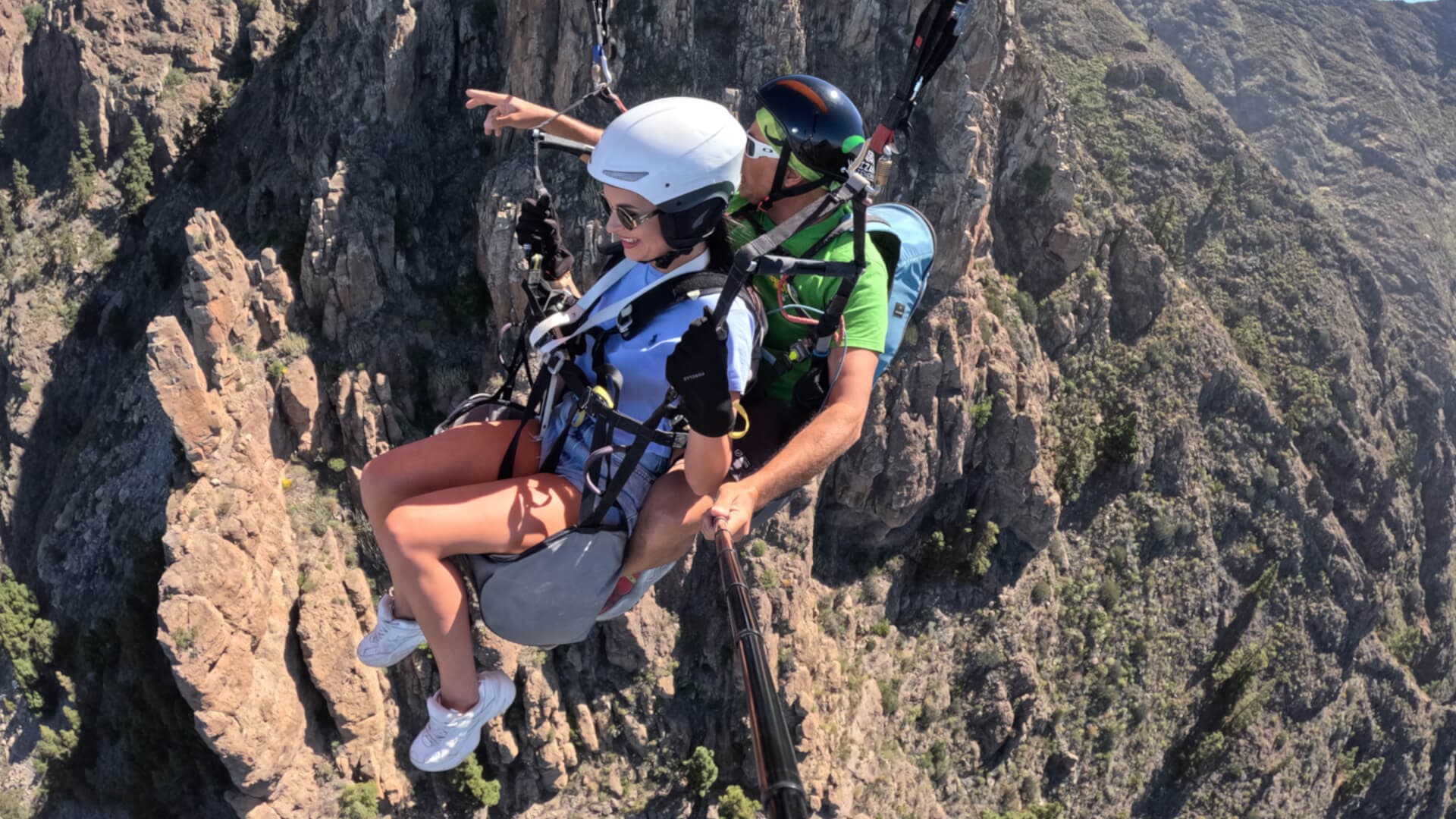
This is not a marketing category. It is a real, specific kind of flight. The pilot explains, during the takeoff climb, how the glider reads the air. Why you turn where you turn. What the ridge is giving you, and what the next thermal will look like. Then, somewhere past the midpoint, they hand you the brake toggles. Under full supervision and with their hands never more than a second away, you fly the glider yourself.
We are the only operator in Tenerife that offers this as a dedicated product. It is called the Instructional Flight. It is not a gimmick. It is exactly how professional pilot schools introduce students to the controls. If you want to leave with an understanding of flying that lasts longer than the photos, this is the flight to book.
Booking experience signals professionalism
Before you pay anyone, look at how they take payment. Can you book online with instant confirmation, or are you locked into a back-and-forth exchange to confirm a slot? Do you see real-time availability for the exact date and time you want?
Is the cancellation policy written on the page, or do you have to ask? What happens if the weather cancels your flight, refund, reschedule, or silence?
These are not luxuries. They are the difference between a weekend hobby and a professional operation. An operator who can show you an available slot for Thursday at 10:00 and take your payment in thirty seconds has invested in the infrastructure that comes with being around for a long time.
Reviews: read the names, not just the stars
Every operator with a Google profile has mostly five-star reviews. That tells you almost nothing. The interesting signal is in the text.
Look for reviews that mention the pilot by name. Rotating-pilot operations get reviews that read the same way, friendly, professional, great views, because the writer did not spend enough time with any one instructor to say anything more specific. Personal reviews where the pilot is named, his background is mentioned, or something specific happened mid-flight suggest a tight team where passengers remember who flew them.
Read five recent reviews on each shortlist candidate. Count the pilot names. It will tell you more than the star rating.
What is actually included in the price?
Transport to and from takeoff, all equipment, and a safety briefing should always be in the base price. If any of those three is an add-on, you are looking at the wrong operator.
Photo and video coverage is where operators differentiate. Some include it; some charge extra. We charge thirty euros for a photo and video package, disclosed on the booking page before you pay. Some operators include it in a higher base price; others charge more on landing. Neither approach is wrong. What matters is knowing in advance.
Ask, before booking: transport included, yes or no? Photos at what price? Hotel pickup covered? If any answer is "we will sort it on the day", book elsewhere.
The site matters less than you think
South Tenerife has two primary takeoff sites, Taucho and Ifonche, both above the Adeje coast. Almost every operator in the south flies from one, the other, or both, depending on conditions. The difference in the view between them is real but subtle.
What actually varies is who is flying you, what kind of flight they built for you, and how long they have been doing it from these two ridges. The mountain is a constant. Everything above it is a choice.
The mountain is a constant. The pilot, the flight, and the operation behind it are the choices you actually make when you book.
Next step
Ten thousand flights over 15+ years. Five flight types, real-time availability, free cancellation up to forty-eight hours.