If you've read about tandem paragliding in Tenerife for more than five minutes, you've seen the names Taucho and Ifonche. Two ridges above Adeje, the same coast, the same landing beach, flown by nearly every operator on the south side of the island. But they are different launches, at different heights, and they give you different flights. Here is how they compare, and which one you are likely to fly.
Taucho: the everyday launch
Taucho is where most of our flying happens. The takeoff sits at around 760 to 800 metres, on the mountainside about 200 metres below the village of Taucho above Adeje, on a wide, open grass shoulder with room for the pilot to lay out the wing on either side. It is the lower of our two launches, and the more forgiving.
The character of flying from Taucho is easy and open. The whole south coast spreads out beneath you, the Barranco del Infierno falls away to the side, and on clear days La Gomera rises out of the Atlantic to the west. The air here is smooth and reliable, which is exactly why it suits a first flight.
Taucho also has steady, dependable thermals through the middle of the day, fed by the slopes below and the prevailing sea breeze. That makes it the natural home for our scenic and gently thermic flights, and the site we launch almost every first-timer from.
It is a genuinely forgiving place: gentle to launch from, roomy in the air, and rarely rough. If you have booked a Calm & Smooth, an Instructional or a Premium flight, this is almost certainly where you will take off.
Ifonche: the high mountain launch
Ifonche is our high-altitude launch, at around 1,100 metres on the ridges above the Barranco del Infierno. It is higher and more exposed than Taucho, a genuine mountain site, quieter and wilder, where the flying gets more serious.
The character of flying from Ifonche is bigger. The extra height and exposure give stronger, more active air, and the ridgelines above the ravine set up the lines our pilots use to fly cross-country, gaining height, moving between ridges, and covering ground rather than circling above the launch.
We use Ifonche for our longest, most committed flying: the Pro XC. It is not a first tandem. It suits people who already know they want distance, altitude and more time in the air, alongside a pilot who knows every line of the mountain.
Because the air is stronger here, we pick the day carefully. When Ifonche comes together, it is the best flying on the island, but it rewards experience rather than a first taste.
Which flights use which site?
The short version: Taucho for almost everything, Ifonche for the Pro XC. Our Calm & Smooth, Instructional and Premium flights launch from Taucho by default, because its lower, smoother air is exactly what those flights are built for. The Pro XC launches from Ifonche, because its height and stronger air are what a cross-country flight needs.
Within that, the pilot still chooses on the day, from the wind direction, the thermal development, the cloud base and the flight you booked. If conditions at the usual site are not right, and it is safe to fly your flight from the other one, that is what happens.
The one rule that never bends: the pilot's safety assessment overrides everything else. If conditions are not safe on the day of your flight, we do not fly. You choose what happens next, a new date or a full refund.
The drive up
Both sites are a short drive above central Costa Adeje, about 25 minutes to Taucho and about 35 to Ifonche, on paved mountain roads. We drive you up and back in our own van, included in every flight, so you do not need a hire car or a 4x4.
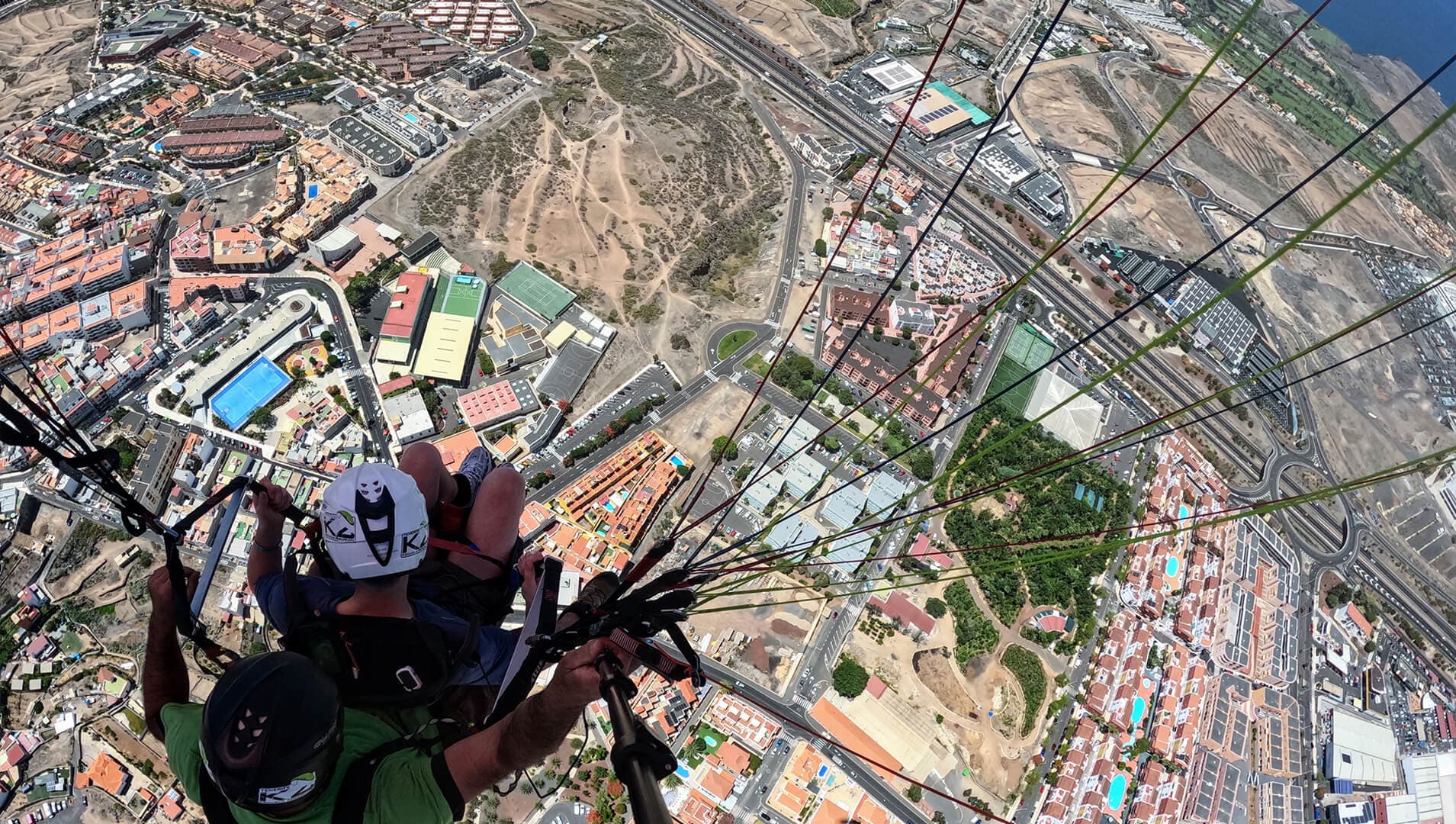
What you notice on the way up: the air cools noticeably, the vegetation changes from coastal scrub to pine, and the view keeps widening until, at the launch, the whole Adeje coast opens up, with Los Cristianos, the airport on a clear day, and El Teide standing over it all inland.
Landing: the same beach for both
Whichever site you launch from, you land at Playa de Enramada in La Caleta. The beach is wide, flat and sandy, and reliably catches a sea breeze in the afternoon, which is exactly what you want for a predictable landing.
The landing itself is straightforward: your pilot lines up into the breeze, flares the wing, and you touch down on your feet or with a gentle sit-down onto the sand. Playa de Enramada is close to most south-coast hotels, so the drive back is short.
Can I choose my site?
You can ask, and we will note it on your booking, but the pilot always has the final say on the day, based on safety and the air. In practice the site follows the flight: if you want Taucho's easy, open coastal flight, book a Calm & Smooth, an Instructional or a Premium. If you specifically want Ifonche, the height, the mountain setting and a real cross-country line, that is the Pro XC.
So what you actually choose is the type of flight, not the ridge. The pilot then launches you from the site that delivers that flight safely on the day.
Weather and seasons
Both sites share the same South Tenerife microclimate: around 300 flyable days a year, thanks to the northeast trade winds (alisios) that shelter the south coast from the rougher weather that hits the north of the island.
Winter, November to March: more consistent conditions, less thermal turbulence, and flights that can be a touch shorter because the lift is weaker. The air is crisp, the views are clean, and first-time passengers often prefer it because it is so gentle.
Summer, June to September: stronger thermals, the chance of longer flights, and the last flight of the day moving from 18:00 in winter to 20:00. Ifonche in summer is superb for the cross-country flying it is built for, while Taucho stays the smoother, more forgiving choice for everyone else.
Shoulder seasons, April to May and October: often the best balance, warm enough to be comfortable, active enough for good flights, and without the peak-summer crowds. For the full month-by-month picture, see our best time to paraglide guide.
Both sites are extraordinary. The one you fly depends on the flight you booked and what the sky offers that day.
Next step
Two ridges, one beach, and a pilot who reads the sky before choosing which side of the mountain you launch from.