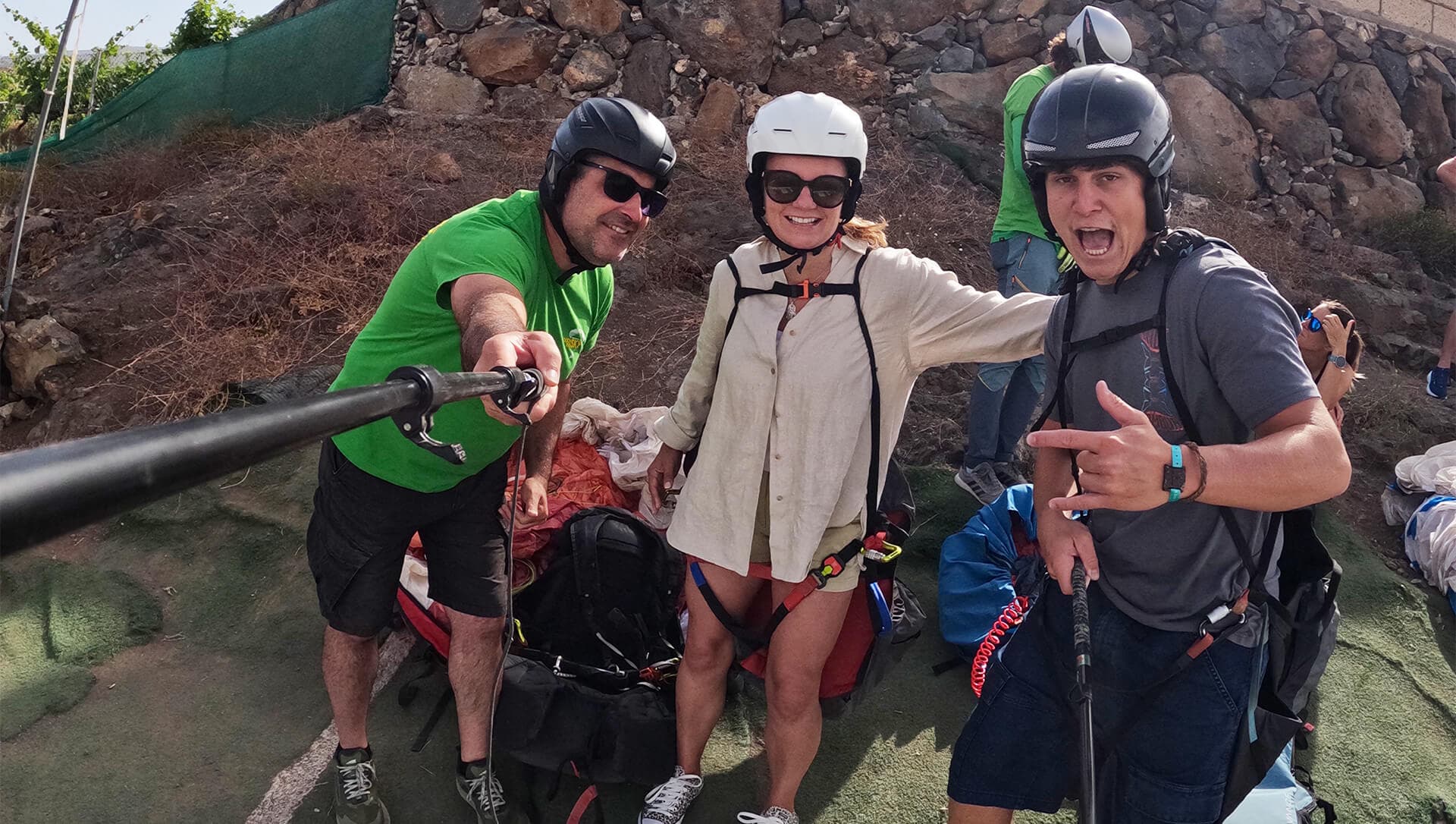
Something changes after you hold the brakes for the first time. You are still technically a passenger, but your hands were on the controls, and the glider responded. That is the moment most pilots point to. This article is about what happens after that moment, if you decide to keep going.
What the learning path actually looks like
Paragliding licences are earned in levels. The international standard used across Europe and most of the world is a progression from P1 (basic supervised flight) through P2 (independent pilot) to P3 (cross-country). Each level unlocks more freedom: where you can fly, what conditions you can fly in, whether you can fly unaccompanied.
Most people who train with us from scratch are flying solo, unassisted, at their own chosen site, in appropriate conditions, within twenty-one days of intensive training. That is the SafePro bootcamp: twenty-one days on Tenerife, daily flights, structured ground school in the evenings, and a certified examiner sign-off at the end.
Twenty-one days is intensive. It is also fast. The reason it works is location: Tenerife has reliable wind structure, multiple sites at different altitudes, and year-round flyable weather. A student in central Europe doing weekend-only training can take eighteen months to reach the same milestone. On Tenerife, the conditions are there every day, you progress at the pace the training is designed for.
The gap between tandem and solo
There is a phase between passenger and pilot that surprises many people: you are in the air, alone under the glider, but an instructor on the radio is giving you commands. This is called radio-guided solo flight, and it is where real learning happens.
The instructor watches from the ground, reads the conditions, and talks you through decisions you do not yet have the pattern-recognition to make on your own. What looks like a student flying solo is actually a student flying with a second brain on a radio. After enough repetitions, the student internalises those decisions and the radio goes quiet.
The Instructional Flight you took with us is the first step into this phase. Your hands were on the brakes. You felt what the glider does when you press left and right. That proprioceptive memory, the feel of the wing, is something no classroom can give you, and it does not go away.
What the SafePro school covers
Ground handling is the foundation. Before you fly, you spend hours on flat ground learning to inflate, position, and control the wing without leaving the ground. It feels tedious. It is also the skill that keeps you safe for the rest of your life as a pilot, because a wing you control on the ground is a wing you understand in the air.
Theory covers meteorology, airspace rules, equipment inspection, emergency procedures, and aerodynamics at a level appropriate to your licence. None of it is abstract: everything is taught in the context of Tenerife's specific wind patterns, sites, and local airspace. You learn why the morning inversion matters for your launch window, not just that it does.
Flying hours accumulate daily. The curriculum is designed so that each day's flights build on the previous day's. Early in the course you fly short circuits, close to the instructor. By the second week you are making real decisions, reading the air, choosing your approach, managing transitions between sites. By the third week you have the hours and the judgment to pass the practical exam.
Equipment: what you need and when you need it
You do not need to own equipment to train. The school provides everything, wing, harness, helmet, radio, reserve parachute, for the full twenty-one days. You use the same equipment your instructor checks every morning.
If you decide to buy after qualifying, the starting budget for a complete new setup is roughly €3,000 to €4,500 for a beginner-intermediate wing, harness, helmet, and reserve. Second-hand from reputable sellers is possible and can cut that by a third, but only buy equipment that has been inspected. A wing that has sat in a garage for four years may look fine and fly badly.
The most common mistake new pilots make is buying too advanced a wing. A beginner wing is designed to be forgiving. An intermediate wing is not. The difference matters most in the situations you have not encountered yet, which, as a new pilot, is most situations. Fly the beginner wing until you are bored of it, not until you think you are ready for more.
Where you can fly after qualifying
A P2 licence is valid across Europe and most of the world. It is your licence, not issued by a school, not tied to a location. You can fly sites in Spain, France, Austria, Switzerland, New Zealand, wherever the local site rules accept your licence level.
Tenerife itself has sites for every level. After qualifying, many graduates fly Ifonche and Taucho independently during their remaining time on the island. Some come back specifically for that, two weeks of school, then a week of free flying before going home.
The transition from structured training to independent flying requires a period of supervised independence: flying at sites where instructors or experienced pilots are around, in conditions well within your demonstrated ability. This is not a rule; it is the thing that keeps your first year enjoyable instead of frightening.
How long it takes and what it costs
The SafePro twenty-one-day bootcamp is the fastest path to a full P2 licence. The course runs on fixed cohort dates through the season. Contact us for current pricing, it varies by season and includes school equipment, all instruction, site transport, and the licence examination.
If you cannot commit twenty-one consecutive days, ask about the modular path: a first week to cover P1, a return trip for the P2 extension. Some students do this across two separate visits, spaced a few months apart. The progression holds because the Instructional Flight experience and ground handling muscle memory does not disappear.
Beyond the course fee, the main cost is your time on the island: accommodation, food, and transport. Most students find the overall cost, course plus living, comparable to a skiing holiday of the same length, with the difference that at the end of a ski holiday you have a tan and some memories; at the end of this one you have a licence.
Who this is and is not for
It is for people who, after their tandem flight, found themselves thinking about the wing more than the view. Who watched other gliders in the sky and mentally tracked their lines. Who looked up flying schools before looking up restaurants.
It is not for people who want a bucket-list story, the tandem flight is the right product for that, and it is excellent. It is not for people who felt that the Instructional Flight was interesting but not compelling. Paragliding training is immersive, physically demanding in a subtle way, and mentally intensive. The people who love it are the people who cannot stop thinking about it after the first flight.
If you are not sure which category you are in, the Instructional Flight itself is the test. If you landed wanting more controls time, more altitude, more days, you have your answer.
The next step
Contact us. The first conversation is always the same: we ask what you flew, what you felt, and what you are considering. From there we can tell you whether the next season has open cohort spots, what the current pricing looks like, and what the realistic path is given your schedule.
If you flew the Instructional Flight and felt the controls respond to your hands, that is enough. Everything else is training.
The wing does not care that it is your first day. It responds to inputs. Every pilot started there.
Next step
Tony has been flying over 15+ years. The SafePro school exists because he wanted to teach the way he wished he had been taught.