
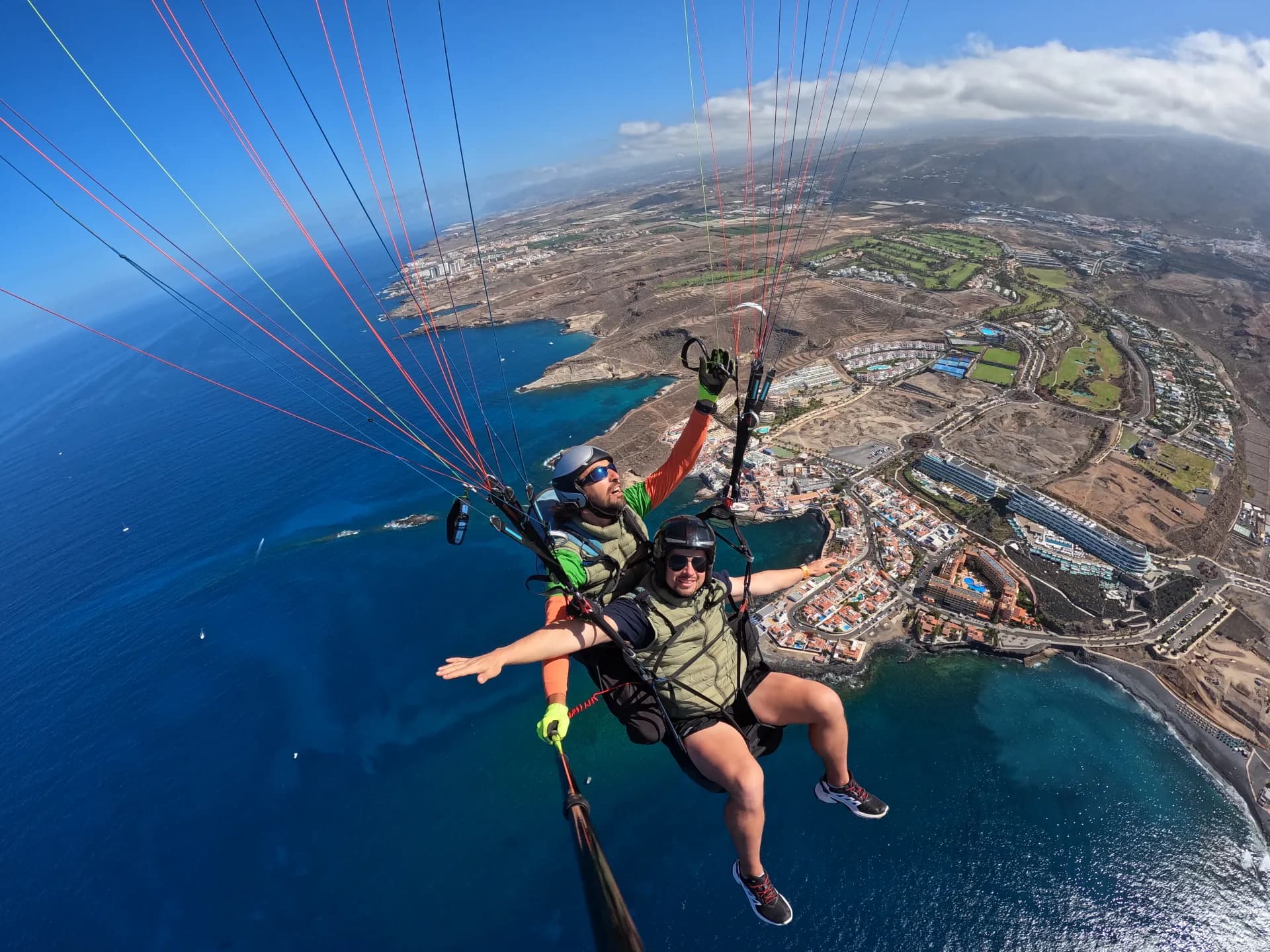
The best time to go paragliding in Tenerife is a friendlier question than it sounds, because the honest answer is almost any time. The south of the island, where we fly, sits in the wind shadow of Mount Teide and stays flyable in every season, something like 300 days a year in a normal year. So this is not about finding the one good window in a short season. It is about knowing the small differences between winter and summer, between one month and the next, and between morning and afternoon, so you can pick the flight that suits you and book it in a way the weather cannot spoil.
The short answer: you can fly all year
You do not need to time your whole trip around the flight. Tenerife's south coast, above Costa Adeje, is sheltered by Mount Teide from the northeast trade winds that make the north of the island cloudier and rougher, which is why we run tandem flights all twelve months of the year. The seasonal differences below are real, but none of them are the difference between flying and not flying. They are the difference between a slightly gentler flight and a slightly livelier one. Pick the time of year that suits your holiday, then use the booking tips at the end so a single windy day never costs you this experience.
Season by season
Winter, November to March, gives the gentlest and most consistent air of the year. The thermals are weaker, so flights can be a touch shorter, but the air is crisp, the long-distance views are at their cleanest, and first-time passengers often prefer it precisely because it is so smooth. It is our quietest, calmest flying.
Summer, June to September, brings the strongest thermals and the potential for longer flights, and the days are long enough that our last flight of the day runs until 20:00 instead of the winter 18:00. It is also the hottest time, around 28 to 30°C on the coast, and the season when the trade winds are at their strongest, so on a windier day your pilot will simply pick the smoother launch or a calmer slot.
The shoulder months, April, May and October, are often the best of both worlds: warm enough to be comfortable, active enough for a good long flight, and without the peak-summer crowds. If you can choose freely, these are lovely months to fly. For a deeper look at how the two launch sites behave through the year, see our Taucho versus Ifonche guide.
Month by month, what to expect
Every month is flyable, and the differences are gentle. Here is the shape of the year, with typical coastal daytime temperatures; remember it is always cooler at the launch than on the beach.
January to March: winter at its clearest. Coastal highs around 22 to 23°C, cool mornings, the calmest and most consistent air, and the cleanest views. Rain is unlikely and brief when it comes, and February is often beautifully still.
April to June: spring warming into early summer. From about 23°C in April to 26°C in June, thermals waking up, long comfortable days, and some of the best all-round conditions of the year, especially April and May.
July to September: the hot heart of summer. Coastal highs of 28 to 30°C, August the warmest, the strongest thermals and the longest possible flights, and light lingering late for evening flights. The trade winds peak now, so the odd day is windier, and that is when the pilot picks the sheltered option.
October to December: easing back toward winter. Still warm at 23 to 27°C, October a genuine sweet spot, thermals softening month by month, and by November and December the year returning to its gentle winter rhythm.
One island-specific thing to know: a calima, a haze of warm Saharan dust, can drift over in any month but is most common in late winter and around late summer. It can soften the views for a few days and, if it comes with strong wind or heat, occasionally ground flights, but it passes.
The best time of day
The air changes through the day as predictably as the seasons change through the year. Early morning and late afternoon are the calmest, smoothest windows, ideal for a first flight or anyone who wants it gentle. The middle of the day, late morning into mid-afternoon, is the most thermic, when the rising air is strongest and longer flights are easiest, which is what you want for a Premium or a cross-country flight.
The launch site plays into this too. Taucho, the lower site at around 800 metres, is the smoother, more forgiving launch we use for most flights; Ifonche, higher at around 1,100 metres, is our stronger, more exposed cross-country site. Your pilot chooses the site and the time slot on the day, from the wind, the cloud base and the flight you booked, so you always catch the best conditions for your flight. In summer the long evenings also open up beautiful late flights toward sunset.
Why a sunny day is not always a flying day
This surprises people, so it is worth saying plainly: a perfect beach day is not the same as a flyable day. What decides flying is the wind direction, the cloud base and the air inland and at altitude, none of which you can read from a sunbed. A clear, hot day with the wrong wind, or a calima blowing through, can be a no-fly even while the coast looks flawless. We only fly in genuinely calm, safe conditions, and never in rain. If we call off your slot on a sunny day, it is not bad luck or bad service, it is the same judgement that keeps every flight safe, and you are never out of pocket for it.
Dress for the launch, not the beach
Whatever the month, it is cooler where you take off than where you are staying. The launch sits at 800 to 1,100 metres, roughly 10 to 15°C cooler than the coast once you add the moving air in flight, so a warm layer is worth packing even in August. You feel it on the thirty-minute drive up, as the coastal scrub gives way to pine. Closed shoes and a light layer turn a slightly chilly flight into a completely comfortable one. You will find the full list in our what-to-wear guide.
How to plan your booking around the weather
Here is the one piece of planning that matters most: book your flight for early in your trip, and leave yourself a spare day or two, never save it for your last morning. That way, if your first choice of day is not flyable, there is room to move. As a rule of thumb, booking about two days ahead is plenty in winter and about five days ahead is wise in summer, when demand is higher. And if the weather does close a day, you are never penalised: you choose a free reschedule or a full refund, whichever suits you. Prices, by the way, are the same in January as in July, so there is no wrong month to come, only the one that fits your trip.
You can fly in Tenerife in any month. The trick is not choosing the perfect season, it is booking early in your trip and keeping a spare day, so the weather never gets the last word.